Technical Architecture
Complete technical overview of ROPAgen's architecture, deployment, and technology stack.
ROPAgen represents a modern, production-ready web application built with industry-leading technologies and best practices. The platform demonstrates excellence in software engineering through its sophisticated architecture, automated deployment pipeline, and cutting-edge user experience design.
Technology Stack
Core Framework & Runtime
ROPAgen is built on Next.js 15, leveraging the latest React 19 features and server-side rendering capabilities. The application utilizes Next.js's App Router for optimal performance and developer experience, with TypeScript providing comprehensive type safety throughout the codebase.
Frontend Technologies
The user interface showcases modern web development practices with a carefully curated technology stack:
- React 19 with the latest hooks and concurrent features
- TypeScript 5 for robust type checking and enhanced developer productivity
- Tailwind CSS 4 for utility-first styling with custom design system integration
- Framer Motion 12 powering sophisticated animations and micro-interactions
- Radix UI components ensuring accessibility compliance and consistent behavior
- next-themes for seamless dark/light mode transitions
AI & Language Models
The document generation engine integrates multiple AI providers for maximum flexibility and reliability:
- OpenAI GPT-4 models via the official AI SDK
- Mistral AI integration for alternative language model options
- Vercel AI SDK providing unified interface for model switching
- Custom prompt engineering optimized for GDPR compliance document generation
Internationalization & Accessibility
ROPAgen supports multiple languages through a sophisticated internationalization system:
- next-intl for comprehensive i18n support (German and English)
- Dynamic locale routing with
/[locale]structure - Server-side translation loading for optimal performance
- Accessible UI components meeting WCAG guidelines
Documentation System
The documentation platform utilizes Fumadocs, a modern documentation framework built specifically for Next.js applications, providing:
- MDX-based content with custom components
- Built-in search functionality
- Responsive design with mobile-first approach
- Syntax highlighting and code examples
PDF Generation & Document Processing
Advanced document generation capabilities powered by:
- Puppeteer for high-fidelity PDF rendering
- Chromium headless browser integration
- Marked for Markdown to HTML conversion
- Custom styling engine for professional document layouts
Database & Authentication
ROPAgen employs Supabase as its backend solution, providing:
- PostgreSQL database for structured data storage
- Built-in authentication and user management
CI/CD Pipeline
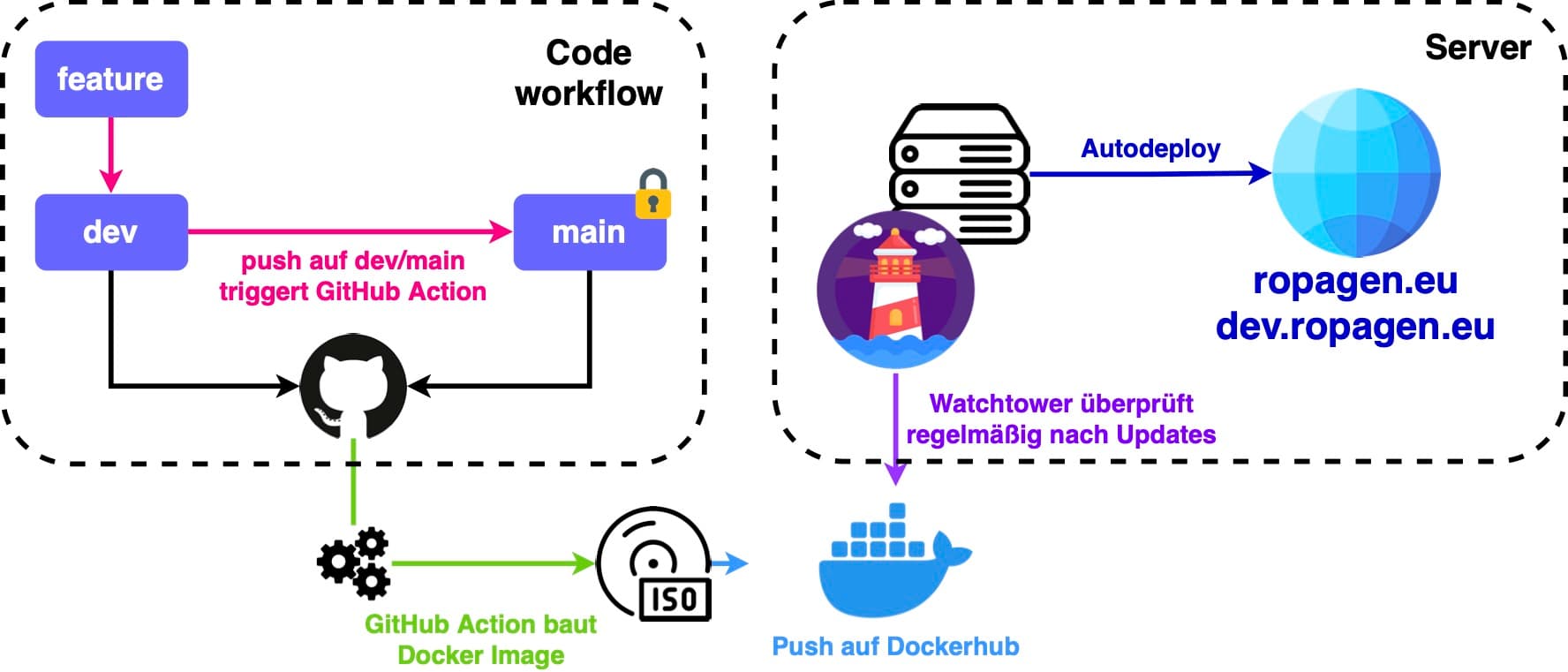
ROPAgen implements a robust three-branch deployment strategy with fully automated continuous integration and deployment:
Branch Strategy
The project follows a structured Git workflow:
- Feature branches → Development work and new features
devbranch → Integration and testing environmentmainbranch → Production-ready releases
Automated Build & Deployment
GitHub Actions orchestrates the entire deployment pipeline, which follows industry standard best practices.
- Trigger Events: Automated workflows activate on:
- Push or merge to
devbranch → deploys to staging - Merge to
mainbranch → deploys to production
- Docker Image Creation:
- GitHub Actions builds optimized Docker images
- Images are automatically pushed to Docker Hub
- Each deployment tagged with commit SHA and branch name
- Automated Container Deployment:
- Watchtower runs on the production server
- Continuously monitors Docker Hub for image updates
- Automatically pulls new images and deploys updated containers
- Zero-downtime deployment with health checks
Deployment Environments
- Staging: dev.ropagen.eu (from
devbranch) - Production: ropagen.eu (from
mainbranch)
This automated pipeline ensures consistent deployments, rapid iteration cycles, and reliable production releases without manual intervention.
Prompt Handling
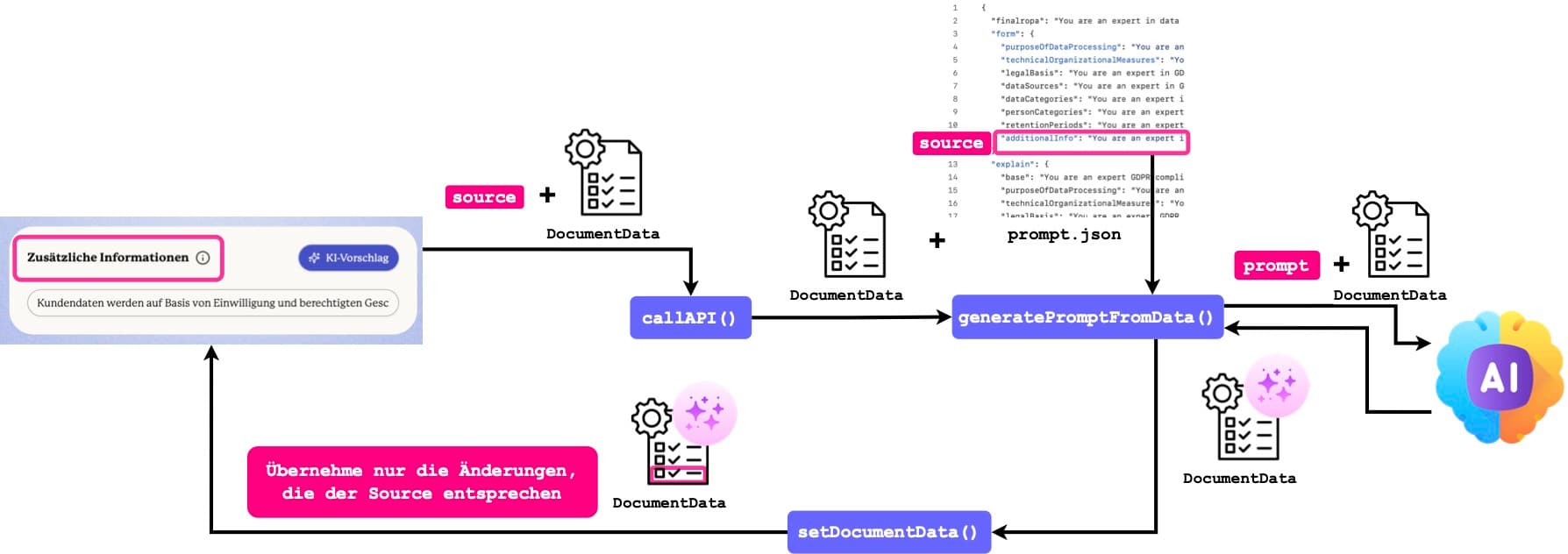
Each button includes an associated "source" that is transmitted with every request to the LLM API. This design enables flexible, source-specific prompt adaptation, allowing each prompt to be tailored to its originating source. The prompt and code are designed so that potential hallucinations do not affect any other part of the ROPA generation process,but are limited only to the specific prompt where they occur. This modular approach enhances reliability and maintainability in the document generation workflow.